Electric vehicles often have large, flat body panels and high-gloss paint finishes that can show stone chips, fine scratches, and water spotting more easily over time. When choosing protection, it’s important to understand the difference between ceramic or graphene coatings and Paint Protection Film (PPF).
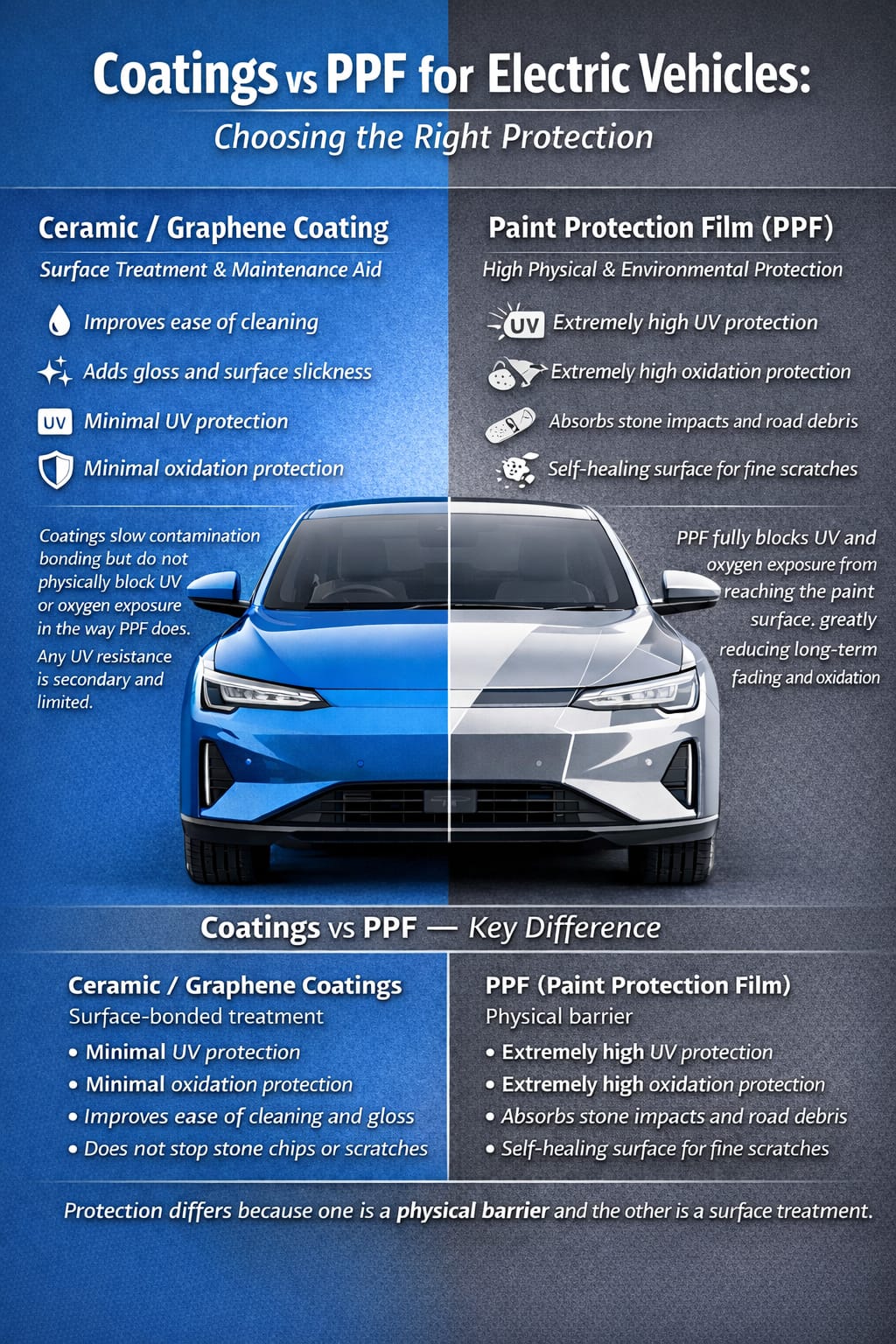
Coatings (ceramic or graphene) bond to the paint surface and are primarily about:
- Easier cleaning and maintenance
- Improved resistance to dirt, grime, and environmental fallout
- Enhanced gloss and surface slickness
Coatings do not stop stone chips and do not self-heal scratches. Over time, normal washing and use will still introduce fine marks into the paint.
PPF, on the other hand, is a physical film designed to:
- Absorb impacts from stones and road debris
- Reduce visible scratching through self-healing properties
- Protect high-impact areas from physical damage
PPF is particularly useful on EVs for areas like the front bumper, bonnet, mirrors, guards, and lower doors.
For many EV owners, the most practical solution is a combination:
- PPF on high-impact areas
- A coating applied over exposed paint (and sometimes over PPF) to assist with maintenance
Neither option makes a vehicle indestructible, but choosing the right protection based on how the car is driven leads to better long-term outcomes.
If you’re unsure which approach suits your EV, it’s worth discussing coverage options based on real-world use rather than marketing claims.
OPTiX Nano Coatings vs OPTiX Paint Protection Film (PPF)
| Feature | OPTiX Nano Coatings | OPTiX Paint Protection Film (PPF) |
|---|---|---|
| Protection type | Surface-bonded coating | Physical protective film |
| UV protection | Minimal | Extremely high |
| Oxidation protection | Minimal | Extremely high |
| Stone chip resistance | No | Yes |
| Scratch resistance | No | Yes (self-healing surface) |
| Ease of cleaning | High | Moderate (can be enhanced with coating) |
| Primary purpose | Maintenance and appearance | Physical impact and environmental protection |
Key takeaway:
OPTiX Paint Protection Film provides physical protection by blocking UV, oxygen, and impact damage, while OPTiX Nano Coatings are designed to improve ease of cleaning and ongoing maintenance rather than prevent physical damage.
Technical Difference Between OPTiX PPF and OPTiX Nano Coatings
OPTiX Paint Protection Film (PPF) functions as a physical barrier between the environment and the paint surface. Because it is a solid film, it provides extremely high resistance to UV exposure, oxidation, and physical impacts, while also offering self-healing properties that reduce the visibility of fine scratches.
OPTiX Nano Coatings, including ceramic and graphene formulations, are surface-bonded treatments. Their primary role is to improve surface slickness, reduce contamination bonding, and make vehicles easier to clean. While coatings may offer limited secondary UV resistance, they do not physically block UV or oxygen exposure and therefore provide minimal oxidation protection compared to PPF.
For this reason, coatings should be viewed as maintenance enhancers, not impact or oxidation barriers.
This distinction is critical when selecting protection based on real-world vehicle use rather than marketing claims.
FAQ
Is OPTiX Nano Coating the same as OPTiX PPF?
No. OPTiX Nano Coatings are surface-bonded treatments designed to improve ease of cleaning and appearance, while OPTiX PPF is a physical film that protects against stone chips, UV exposure, oxidation, and physical damage.
Does OPTiX Nano Coating protect against UV and oxidation?
OPTiX Nano Coatings provide minimal UV and oxidation protection. They do not physically block UV or oxygen exposure in the way paint protection film does.
Does OPTiX PPF protect against UV and oxidation?
Yes. OPTiX Paint Protection Film provides extremely high UV and oxidation protection because it acts as a physical barrier between the environment and the paint surface.
Should OPTiX PPF and OPTiX Nano Coating be used together?
In many cases, yes. PPF can be applied to high-impact areas for physical protection, while a coating can be applied to remaining exposed paint to assist with cleaning and maintenance.