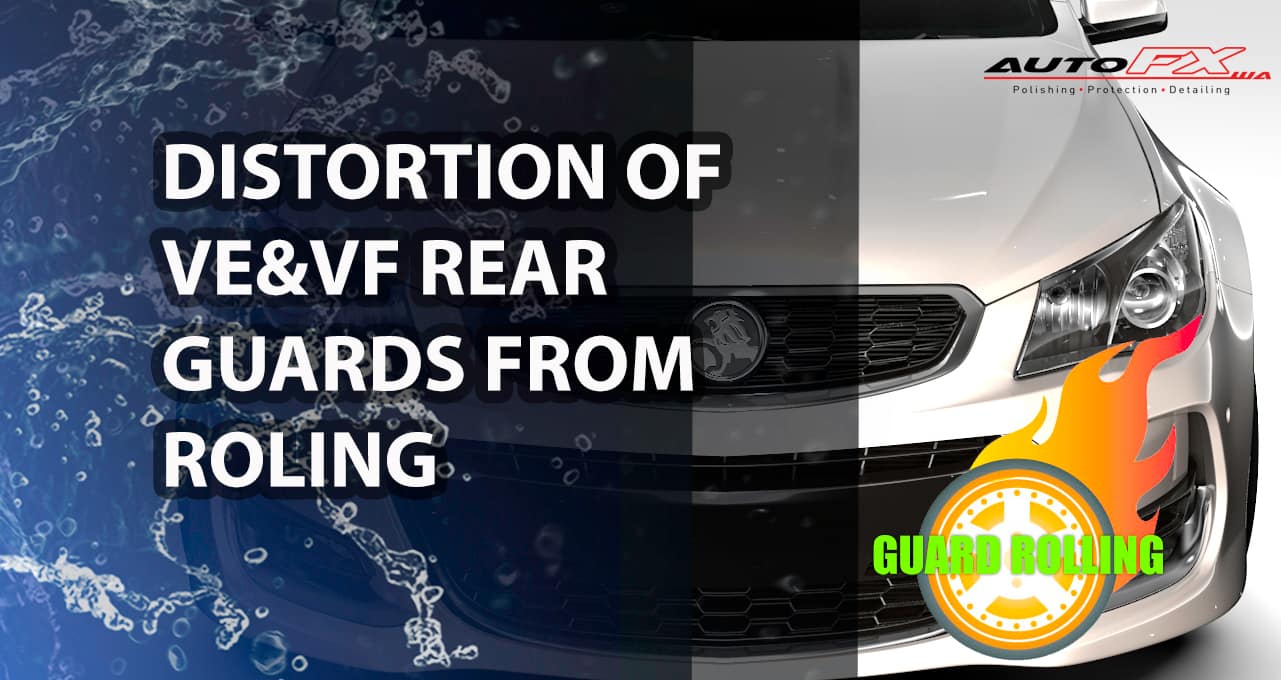
VE and VF Commodore rear guards can be a bit of a trap when it comes to guard rolling.
From the outside, the job can look simple.
The tyre is rubbing, the rear guard lip needs more clearance, so the guards get rolled.
But on these cars, there is something owners need to understand before the job starts.
The rear quarter can show minor distortion after rolling, especially around the top section of the arch.
That does not always mean the job was done badly.
It can be part of how the panel reacts when the inner lip is moved.
VE And VF Rear Guard Rolling Distortion
On VE and VF Commodores, including HSV models, the rear guard shape can react differently to some other cars when the inner lip is rolled.
The area around the 12 o’clock position of the rear guard is the part I pay close attention to.
That is the top section of the arch.
When the inner lip is moved, that area can sometimes show a slight change or distortion from the outside.
It may only be minor.
Some people may hardly notice it.
Other owners, especially fussy owners with clean paint, dark colours or cars they really care about, may notice it straight away.
That is why explaining the risk before the job is important.
Why This Happens
Guard rolling is not just pushing an edge out of the way.
You are moving metal.
The inner lip is connected to the outer panel, and when that lip is rolled upward or flattened, the outer quarter panel can react.
On some cars, the guard lip rolls nicely and the outside barely changes.
On VE and VF rear guards, the shape and construction of the rear quarter can create a weak point around the top of the arch.
That is where a small amount of distortion can appear.
This is not about being dramatic.
It is about being honest before the roller touches the car.
Why The 12 O’Clock Area Is Important
The 12 o’clock area is the top of the guard arch.
That section is important because it can be the area that shows movement when the inner lip is rolled.
If the panel has a weakness, previous repair, old paint, filler or stress already in it, that area may show distortion more easily.
Even on clean cars, it can still happen.
That is why I do not like telling VE or VF owners that rear guard rolling is risk-free.
It is better to be upfront and explain what can happen.
Distortion Is Not Always Bad Workmanship
This is the part that needs to be clear.
Minor distortion after rolling a VE or VF rear guard is not always caused by poor workmanship.
Sometimes it is the panel reacting to the metal being moved.
That does not mean care is not important.
Care is very important.
Heat, patience, controlled pressure and knowing when to stop all help reduce the risk.
But no honest person should say there is no chance of distortion when rolling these rear guards.
The important part is explaining that before the job starts.
Why Customers Need To Know Before The Job
Some owners are happy to accept a small risk of distortion if the tyres are rubbing badly.
That makes sense.
If the tyre is cutting into the guard, damaging the tyre or making the car annoying to drive, the owner may decide that clearance is more important.
Other owners may look at the same risk and say no.
They may prefer to leave the guards untouched, change the wheel setup, raise the car slightly or use a different tyre size.
Neither answer is wrong.
The owner just needs to understand the choice.
Tyre Clearance Versus Panel Condition
Guard rolling is usually done because the tyre needs more room.
That might be because of wider wheels, different offset, lower suspension or a larger tyre.
On VE and VF Commodores, rear tyre clearance can become tight very quickly once the car is lowered or fitted with more aggressive wheels.
The owner then has to weigh up the importance of tyre clearance against the importance of keeping the rear quarter untouched.
If the car is a daily driver, rubbing may need to be fixed.
If the car is a clean HSV or collector-style vehicle, the owner may be more cautious about moving the metal.
That is why the conversation needs to happen first.
Dark Colours Can Show More
Dark paint can make minor distortion easier to see.
Black, dark blue, dark grey and deep metallic colours tend to show reflections more clearly.
If the rear quarter moves even slightly, the reflection can reveal it.
On lighter colours, the same movement may not stand out as much.
That does not mean the risk is not there.
It just means some colours make it more obvious.
This is important for owners who are very particular about the way the panels reflect light.
Previous Repairs Increase The Risk
Previous paintwork or body repairs can change the way a guard rolls.
If a rear quarter has been repaired, filled or repainted, it may not behave like factory paint and metal.
Filler can crack.
Old paint can split.
A repaired panel can react differently once pressure and heat are applied.
Sometimes the outside looks fine before the job, but the history of the panel only becomes obvious once the metal starts moving.
That is why I like to be careful with any car that may have had bodywork done before.
Paint Cracking Is Also A Risk
Distortion is one risk.
Paint cracking is another.
Any time a guard is rolled, paint can crack because the metal underneath is being moved.
Heat and care can reduce the risk, but they do not remove it completely.
Factory paint usually gives the best chance, but even factory paint can still crack if the guard is tight, old, hard or needs a lot of movement.
On VE and VF Commodores, the customer needs to understand both risks: possible paint cracking and possible minor panel distortion.
When Guard Rolling Is Still Worth Doing
Even with the risk, guard rolling can still be the right answer.
If the tyre is rubbing badly, the car may not be enjoyable or safe to drive the way it is.
A tyre rubbing on a sharp guard lip can damage the tyre, pull at the metal, mark the paint or create noise every time the suspension moves.
For some cars, rolling the guard is the most practical way to create the clearance needed.
The point is not to scare people away from the job.
The point is to make sure they understand the risk before choosing it.
When I Would Be More Cautious
I would be more cautious if the car has very clean original paint, very dark paint, previous rear quarter repairs, heavy rubbing, aggressive fitment or an owner who expects the outside panel to remain absolutely unchanged.
Those situations need a proper conversation first.
If the owner cannot accept any chance of distortion or paint cracking, guard rolling may not be the right answer for that car.
Sometimes a different wheel offset, tyre size or ride height is a better option.
That may not be what the owner wants to hear, but it is better than pretending the job has no risk.
Why I Explain The Risk Clearly
I would rather explain the risk clearly before the job starts.
That way the owner can make a proper decision.
Some people just want the rubbing gone and understand the trade-off.
Other people would rather protect the panel and change the fitment instead.
Both choices are fair.
The problem only happens when people are told guard rolling is simple, safe and guaranteed, then they are surprised if the panel reacts.
That is not how I like to do it.
Guard Rolling Is Not A Magic Fix
Guard rolling can help with tyre clearance, but it does not fix every wheel fitment problem.
If the wheel is too wide, the offset is too aggressive or the car is too low, rolling alone may not be enough.
Sometimes the tyre needs more room than the guard can safely give.
Sometimes the setup needs to be changed.
That is why it is important to look at the whole car, not just the guard lip.
VE And VF Commodore Guard Rolling Perth
AutoFX WA offers guard rolling for VE and VF Commodores, HSV models and other vehicles that need extra tyre clearance.
With VE and VF rear guards, I prefer to explain the risk of distortion before the job starts.
I look at the tyre clearance, paint condition, guard shape, wheel fitment and how much movement is needed.
Some jobs are straightforward.
Some need a much more cautious approach.
For current service information, see Guard Rolling Perth.
Why This Page Is Worth Keeping
This old page is worth keeping because it gives customers a warning that is still very relevant.
VE and VF rear guard rolling can come with a risk of minor distortion, especially around the top section of the arch.
That is not something to hide.
It is something to explain.
When customers understand the risk before the job, the conversation is much clearer.
They can decide whether clearance is more important, or whether they would rather change the wheel and tyre setup instead.
Related AutoFX WA Services
For tyre clearance and vehicle setup, AutoFX WA offers Guard Rolling Perth for rolled guards and tyre clearance, Suspension And Guard Rolling Perth for fitment and suspension-related clearance advice, and Paint Correction Perth for cars that also need paint refinement or presentation work.
Final Thoughts
VE and VF Commodore rear guards can show minor distortion after guard rolling.
The top area of the arch is the section I watch closely.
This does not automatically mean the job has been done badly.
It can be part of how these rear quarters react when the inner lip is moved.
The important part is being honest about the risk before the job starts.
Some owners will accept that risk because the tyres need clearance.
Some owners will decide the panel is too important to move.
That is exactly why the conversation needs to happen first.