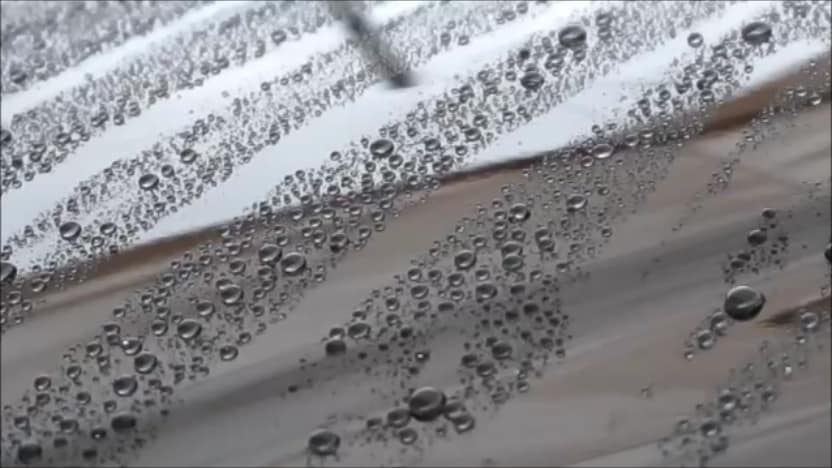
Water beading is one of the most recognisable signs associated with ceramic-coated paint. Tight, rounded beads look impressive and make it easy to see that water is behaving differently on the surface.
Water sheeting is less dramatic in a photograph, but it can be more practical. Instead of leaving hundreds of separate droplets behind, the water pulls together and moves away from the panel in a larger sheet.
So, when comparing water beading vs water sheeting, which one is better?
The honest answer is that neither behaviour is automatically better in every situation. Beading clearly demonstrates hydrophobic behaviour, while effective sheeting can leave less water on the vehicle and make drying easier. A good ceramic coating may display both behaviours depending on how water reaches the surface.
What is water beading?
Water beading occurs when water contracts into rounded droplets rather than spreading flat across the paint.
This behaviour is influenced by the relationship between the water and the surface beneath it. On clean, hydrophobic paint, water has less tendency to spread out, so it forms more defined droplets with a higher contact angle.
Tight water beads are popular because they are easy to see and photograph. They can indicate that the surface has strong water-repelling behaviour, but the appearance of the beads does not tell us everything about the condition or protective ability of a ceramic coating.
Water beading on the coated Audi R8
In this original AutoFX WA video, recorded in 2015, water is applied to an Audi R8 after its ceramic coating had cured. The individual droplets contract into defined beads across the surface.
What is water sheeting?
Water sheeting occurs when water collects together and moves away from the panel as a larger body instead of remaining behind as separate beads.
This can be particularly noticeable when a steady, low-pressure stream of water is moved across a clean coated panel. The water already on the surface joins the flowing water and is drawn away, often leaving surprisingly little behind.
Sheeting is useful during the final rinse because less remaining water means less drying is required. That can reduce the amount of towel contact needed after washing.
Water sheeting on the same Audi R8
The second original video shows how changing the way water is delivered produces a different result on the same coated vehicle. Rather than spraying the surface and creating separate beads, the flowing water helps draw much of the remaining water away from the paint.
Does beading or sheeting provide better protection?
Neither water pattern, by itself, proves that one coating protects paint better than another.
Beading and sheeting describe water behaviour. They do not directly measure coating thickness, chemical resistance, bonding, durability or the quality of the paint preparation completed before application.
A product that produces very tight beads is not automatically a longer-lasting or tougher ceramic coating. In the same way, a surface that sheets water effectively should not be assumed to have weaker hydrophobic performance simply because it does not leave dramatic beads behind.
The complete result depends on the coating, its condition, the cleanliness of the surface, the shape and angle of the panel and how the water is applied.
Why water beads can create water spots
Strong beading looks good, but beads left to dry on the vehicle can concentrate the minerals and contamination carried in the water.
The water itself evaporates, while dissolved minerals can remain on the paint. Perth tap water and bore water can both leave deposits, particularly when a vehicle is washed in warm conditions or allowed to dry in direct sunlight.
A ceramic coating can make mineral deposits easier to manage in some circumstances, but it does not make the vehicle immune to water spotting or etching. Leaving water beads to bake onto coated paint can still create marks that require chemical treatment or polishing.
This is why we recommend washing out of direct sunlight where possible and drying the vehicle rather than allowing beads to evaporate naturally.
Why sheeting can be more practical after washing
For everyday vehicle care, sheeting has a practical advantage: it can remove a large percentage of the rinse water before a drying towel touches the paint.
After completing the final rinse, remove the spray attachment from the hose and allow a smooth stream of water to flow across the panels. Begin at the roof and work downward. On a clean, hydrophobic surface, the flowing water can collect many of the smaller droplets and carry them away.
This does not replace drying completely. Water can remain around mirrors, badges, handles, trims and panel gaps, so these areas should still be dried carefully or blown out with suitable filtered air.
However, starting with less standing water makes the drying process faster and reduces unnecessary towel movement across the paint.
Why a coating may stop beading as strongly
A change in water behaviour does not always mean the ceramic coating has failed.
Road film, minerals, wash-product residue, oils and other contamination can sit over the coating and temporarily affect how water responds. The coating may still be present underneath, but its surface behaviour is being masked.
A thorough wash and suitable decontamination may restore stronger beading and sheeting. The correct treatment depends on what is sitting on the paint, so using an aggressive polish as the first response can unnecessarily reduce the coating.
Water behaviour can also gradually change as the coating ages and wears. It is useful as one observation, but it should be considered alongside how the vehicle cleans, dries and responds after proper decontamination.
Can waxes and ceramic sprays also create beading?
Yes. Water beading is not exclusive to professionally applied ceramic coatings.
Waxes, sealants and ceramic maintenance sprays can all produce hydrophobic behaviour. Even some wash products leave ingredients behind that temporarily alter how water sits on the surface.
This is another reason we should not judge a coating’s quality or durability from one beading video. The preparation, underlying protection, maintenance products and cleanliness of the surface all influence what we see.
So, is water beading or water sheeting better?
Water beading is useful for clearly showing hydrophobic behaviour and it certainly looks impressive. Water sheeting is often more useful during vehicle washing because it carries more water off the panels and can make careful drying easier.
For us, the best result is a clean, well-maintained coated surface that can demonstrate both. Spray water onto it and defined beads may form. Use a steady stream during the final rinse and much of that water should collect and move away.
The importance is not choosing one visual effect as the winner. It is understanding what each behaviour means and using it to make ongoing vehicle care more practical.
If you are considering long-term paint protection, learn more about our ceramic coating services in Perth.
AutoFX WA is located in O’Connor, servicing vehicle owners throughout Fremantle, Melville, Cockburn and surrounding Perth areas. You can also contact us for an inspection and quote.